
If you are responsible for maintaining a municipal wastewater lagoon, industrial settling basin, or agricultural manure lagoon, you are likely familiar with the same recurring challenges: high hauling costs, persistent free liquids that fail landfill acceptance tests, and the constant risk of damaging lagoon liners during cleanout operations.
Traditional approaches—such as adding sawdust, wood chips, or lime—often create more problems than they solve. These materials increase waste volume, add unnecessary weight, and introduce new safety, environmental, and regulatory risks.
This article outlines a proven, field-tested solution based on modern polymer solidification technology, offering a smarter and more reliable way to manage lagoon dredging projects.
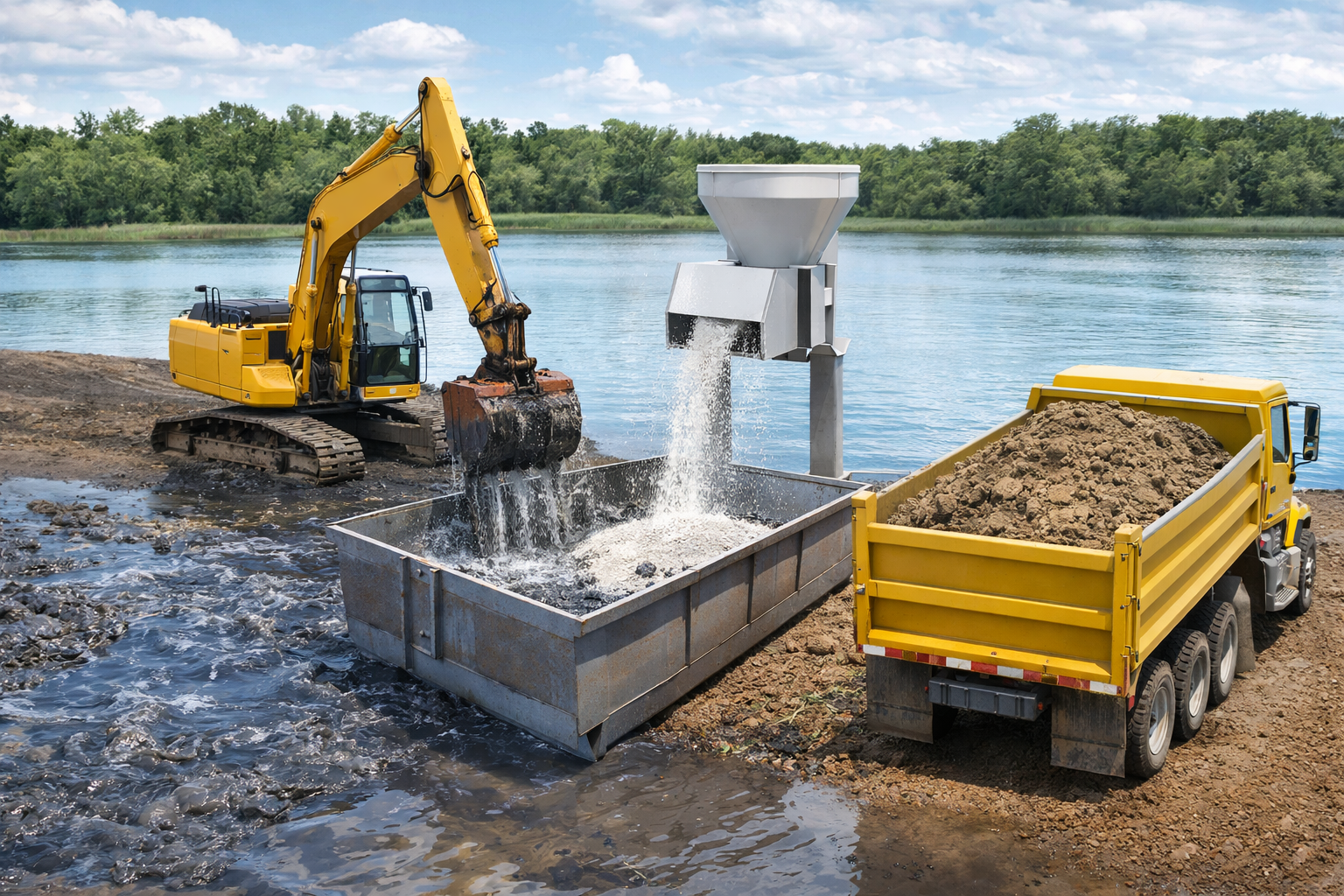

What’s Really Driving Cost and Risk in Lagoon Dredging?
You’re Paying to Transport Water
Dredged lagoon material typically contains 85–95% water. Transporting this slurry in liquid form requires more trips, higher fuel consumption, and increased labor costs—dramatically inflating project budgets.
Landfill Rejections Due to Free Liquids
Loads containing free liquid fail the EPA Paint Filter Liquids Test (Method 9095B). Rejected loads lead to delays, rehandling, and unplanned onsite remediation.
Bulking Agents Increase Volume and Cost
Materials such as sawdust or corn cobs can double—or even triple—the volume of waste. More volume means more trucks, higher tipping fees, and longer project timelines.
Risk to Lagoon Liners
Lime and cement-based treatments are heavy and chemically aggressive. Their exothermic reactions and extreme pH shifts can damage HDPE or clay liners, increasing the risk of costly repairs and environmental exposure.
A Smarter Solution: Polymer Solidification with GELSAP
GELSAP is a high-performance polymer engineered specifically for water-based sludges, including lagoon sediments with elevated salinity. Unlike traditional absorbents that merely soak up liquid, GELSAP chemically binds water through rapid cross-linking, transforming liquid slurry into a stable, solid material.
The result is a shovel-ready, stackable mass that is safe to handle, easy to transport, and compliant with landfill requirements.
Key Performance Benefits of GELSAP
Rapid Solidification
GELSAP converts liquid sludge into a transportable solid within minutes, typically achieving paint-filter compliance in 15–30 minutes after mixing.
Extremely Low Dosage
Effective at approximately 0.5–1.5% by weight, GELSAP requires far less material than conventional bulking agents, which may require 50–100% addition.
Minimal Volume Increase
Solidification with GELSAP typically results in less than 1% volume increase, preventing unnecessary hauling and disposal costs.
Liner-Safe Chemistry
GELSAP is non-corrosive, produces no heat, and does not significantly alter pH—making it safe for both HDPE and clay-lined lagoons.
Landfill Acceptance
Formulated to meet EPA Method 9095B, GELSAP-treated material passes paint filter tests and supports smooth landfill tipping with minimal rejection risk.
How GELSAP Works in the Field
Step 1: Dredging or Pumping
Lagoon sediments are removed via mechanical or hydraulic dredging and transferred to a mixing area or treated inline during pumping.
Step 2: Polymer Dosing and Mixing
GELSAP is added at a typical rate of 0.5–1.0%. Basic mechanical mixing or natural agitation during pumping is sufficient—no centrifuges, belt presses, or thermal treatment required.
Step 3: Verification and Transport
Within minutes to hours, free liquid is immobilized. The solidified material is ready for loading into standard dump trucks and transport to disposal or reuse sites.
Why Polymer Solidification Reduces Cost and Improves Schedules
Fewer Truckloads
Solidified sludge can be hauled using standard dump trucks instead of vacuum tankers, significantly reducing per-mile hauling costs.
Lower Disposal Fees
Minimal volume increase and reliable landfill acceptance reduce tipping fees and eliminate costly rework.
Reduced Equipment and Labor
No large dewatering systems, curing pads, or long processing times—projects are completed faster with fewer personnel and less site disruption.
Improved Safety and Reliability
With no heat generation, no corrosive chemistry, and fewer moving parts, GELSAP improves worker safety and protects critical infrastructure.
Ideal Applications for GELSAP Polymer Solidification
Mechanical Dredging
Immediate stabilization of thick, high-solids sludge recovered by clamshell buckets or excavators.
Hydraulic Dredging
Inline polymer dosing during pumping to containment areas or geotextile tubes for faster water immobilization.
Dewatering Bags and Tubes
Enhances water removal efficiency, improves bag stability, and shortens dewatering cycles.
Emergency Spill Response
Rapid immobilization of liquid waste to prevent off-site migration and environmental damage.
Beneficial Reuse Opportunities
Creates a soil-like, stackable material suitable for certain backfill or land restoration uses, subject to local regulations.
Conclusion
Lagoon dredging doesn’t have to mean excessive hauling costs, liner damage, or landfill rejections. Polymer solidification with GELSAP offers a modern, efficient, and field-proven solution that addresses the real drivers of cost, risk, and delay.
By converting liquid sludge into a stable, landfill-ready solid quickly and safely, GELSAP helps operators complete projects faster, reduce expenses, and maintain compliance—without compromising lagoon infrastructure or environmental safety.

 Íslenska
  English
  Deutsch
  Español
  Français
  Русский
  日本語
日本語  العربية
  Italiano
  한국어
한국어  Tiếng Việt
  简体中文
简体中文  Dansk
Dansk  हिन्दी
  Suomi
Suomi  Bahasa Indonesia
  English (South Africa)
  English (Australia)
  English (Canada)
  English (New Zealand)
  香港中文
香港中文  繁體中文
繁體中文